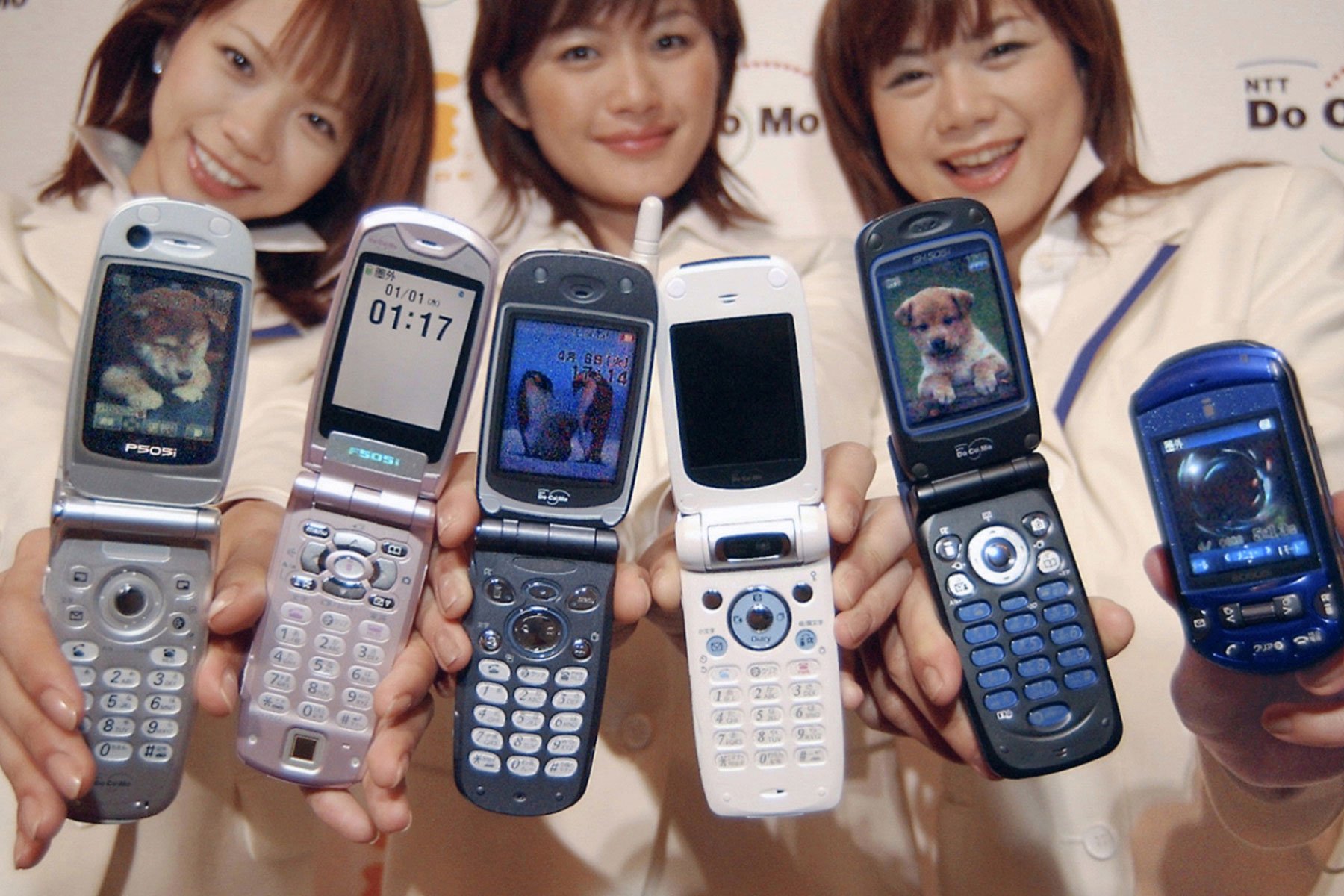
Before the iPhone, a Japanese phone shop could look like a display of closely related species. Most handsets had a small screen, a hinge or slider, a numeric keypad, and a dense arrangement of buttons. Look more closely and the differences accumulated. One model opened sideways to show television. Another put a camera above the outer display. Carrier menus, payment systems, mail, emoji, games, and web services varied between devices that shared the same basic silhouette.
These phones are now commonly grouped under one name: ガラケー (garakē).
The word contains a history of technology developing inside a local
environment—and a possible name for what AI is doing to software now.
ガラケー joins Galápagos to mobile phone
The full Japanese word for mobile phone is 携帯電話 (keitai denwa),
literally a portable telephone. In ordinary speech it was shortened to 携帯
(keitai), often written phonetically as ケータイ.
ガラケー abbreviates ガラパゴス携帯: Galápagos mobile phone.
| Japanese | Rōmaji | English |
|---|---|---|
ガラパゴス | garapagosu | Galápagos |
携帯電話 | keitai denwa | mobile phone |
携帯 / ケータイ | keitai | mobile phone (short form) |
ガラパゴス携帯 | garapagosu keitai | Galápagos mobile phone |
ガラケー | garakē | Japanese feature phone |
flowchart LR
  A["ガラパゴス携帯<br/>garapagosu keitai"] --> B["ガラ<br/>from ガラパゴス"]
  A --> C["ケー<br/>from ケータイ(携帯)"]
  B --> D["ガラケー<br/>garakē"]
  C --> D
The Galápagos reference does not mean that the phones were primitive. Japanese handsets acquired capabilities early. NTT DoCoMo launched i-mode in 1999, and later phones combined mobile web access with cameras, GPS, water resistance, and Osaifu-Keitai electronic payments. The problem was that this sophistication evolved around Japanese carriers, standards, manufacturers, and consumer habits. Features fitted the local ecosystem closely but did not travel cleanly into the rest of the world.
That condition became ガラパゴス化 (garapagosu-ka): Galápagosization.
A globally familiar product had followed a branch shaped by isolation.
ガラケー named the handset produced by that branch. After smartphones
became dominant, the word also became a convenient contrast term for older
feature phones, even when their particular features were not uniquely
Japanese.
The biological metaphor is variation under local pressure. The Galápagos finches are closely related, but their beaks and body sizes vary with food and habitat. A small set of visible changes separates forms adapted to different niches. Japanese phones produced a comparable visual experience: a row of related devices, each adjusted to a slightly different combination of carrier, manufacturer, and use.
AI lowers the minimum viable habitat
Conventional software needs enough users or revenue to pay for its creation and maintenance. That economic threshold suppresses many variants. A developer may dislike one part of an application, but rebuilding the application costs more than tolerating the mismatch.
AI coding tools lower that threshold. A person can describe the missing behavior, generate a working version, and revise it without first assembling a team or raising enough money to support one. The relevant market can shrink from thousands of customers to a department, a group chat, a family, or one person with an inconvenient workflow.
As the viable habitat gets smaller, more software can survive:
- another Markdown editor with one different publishing path;
- another issue tracker fitted to one team’s vocabulary;
- another personal finance tool with the exact categories its author uses;
- another Git interface built around a particular interpretation of branches;
- another internal dashboard that differs from three nearby dashboards by one filter and one approval step.
Many of these programs will look almost identical. Some will duplicate work that an existing setting or contribution could have handled. Others will contain a small difference that matters intensely to their few users. From a distance, both cases look like redundancy.
AI makes implementation cheaper faster than it makes coordination cheaper. Finding an existing project, understanding its design, negotiating a change, and waiting for maintainers still require attention. Starting a new repository now offers an immediate path around those costs. The result is not only more software, but more independent branches of the same idea.
Two Git servers met on X
On 24 August 2026, Shopify CEO Tobi Lütke published
walgit, an open-source Git server he had
built over a weekend after reading Cursor’s account of its large-scale Git
architecture. The implementation uses an object store as the durable source of
truth, records pushes in a write-ahead log, and treats local repositories as
disposable caches.
GitButler CEO Scott Chacon then replied on X:
It’s hilarious, I did this too: https://t.co/jqmEY2P8c3
— Scott Chacon (@chacon) August 24, 2026
Mostly to see how it worked, but its turned into a fun, working project. https://t.co/PTUTsTkrLH
His project, gitwal, also puts a Git host in front of an
object store, uses a write-ahead log as the source of truth, and treats local
disk as a cache that can disappear. Both projects cite the same Cursor article
as inspiration. Their names even invert the same two words: walgit and
gitwal.
They are not identical products. Their authentication, interfaces, deployment choices, and ambitions can diverge. Nor does the exchange establish how much of either codebase was generated by AI. It shows the development tempo that AI now amplifies: two experienced builders can encounter the same technical idea, implement substantial versions independently, and discover the duplication only after both are public.
Previously, the cost of building a Git server would have pushed more people to coordinate before implementing. Now implementation itself can be a way to understand an idea. The prototype is no longer merely a plan for the work; it is what a person can produce while deciding whether the idea is worth pursuing.
Gara-ware is software adapted to one island
I want a term for the output of this new condition: gara-ware, or Galápagos software.
The term is not automatically an insult. The original Japanese phones show why. Local adaptation produced real capabilities for Japanese users. Isolation became a liability when the surrounding market converged on another platform, but divergence and inferiority were never synonyms.
Gara-ware can likewise fit its users better than a mass-market application. A tool built for one laboratory can encode its actual instruments. A family calendar can use the family’s own rules without turning those rules into a settings screen for millions of strangers. A programmer can test an architecture by constructing it rather than arguing about it in the abstract. Several independent implementations can also expose which parts of an idea are essential and which were accidents of the first version.
The cost appears later. Each variant acquires dependencies, security failures, data formats, accessibility gaps, and maintenance work. Ten similar tools do not share fixes merely because the same model helped create them. If their data cannot move between them, a user’s local improvement becomes another island they cannot leave. Cheap creation can therefore produce expensive continuity.
The distinction is whether variation accumulates above a shared substrate or inside sealed applications. Variants that share protocols, data, and reusable parts can exchange improvements. Variants that each own the entire stack repeat the same infrastructure and trap their differences behind incompatible boundaries.
The iPhone moved variation from buttons into software
When Steve Jobs introduced the iPhone in 2007, he contrasted its large multi-touch screen with smartphones covered in fixed controls. A plastic button is committed at the factory. If an application needs a different control, the hardware cannot become something else.
The iPhone replaced most of that fixed surface with pixels. Its keyboard could appear when text entry was required and disappear afterward. Each application could present controls fitted to the current task. Apple’s launch announcement described the mechanism directly: software and a multi-touch display replaced the small plastic keyboards used by contemporary smartphones.
That change did not eliminate variation. It consolidated variation onto a malleable surface. Instead of manufacturing another handset for each button layout, developers could redraw the same screen.
Software may be approaching an equivalent choice. We can use AI to manufacture another complete application whenever a local need appears. That path produces gara-ware indefinitely: many recognizable products with slightly different controls, data models, and assumptions.
Or we can make the underlying software more changeable.
Ink & Switch calls this malleable software: an ecosystem in which people can adapt their tools with little friction. Its proposal does not require everybody to recreate every application. It calls for a gradual path from use to modification, tools that operate on shared data, interfaces that can be composed, and communities that can exchange local changes.
That model turns an isolated fork into a possible customization. The person who needs one extra field should be able to add a field, not commission another project-management system. The person who wants a different view should be able to place another tool over the same data, not migrate the data into a new application. AI can help create the change, while the substrate keeps identity, history, permissions, and interoperability intact.
Proliferation and consolidation can happen together
We may continue building similar but different things forever. The falling cost of implementation makes that likely, and many local variants will deserve to exist. The mistake would be to conclude that every variation requires an independent application.
Consolidation does not have to mean one vendor selecting one interface for everyone. It can mean agreement at lower layers: common document formats, stable protocols, shared identity, portable history, and components that can be replaced without abandoning the surrounding system. Above those layers, variation can accelerate.
The future may therefore contain both more software and fewer fixed applications. AI supplies an abundance of implementations. Malleable systems could give those implementations somewhere to meet, exchange parts, and remain legible to one another.
The alternative is an archipelago of programs: each easy to create, each adapted to its builder, and each separated by a short stretch of water that no one remembered to bridge.